Home / Destinations / San Francisco / Ghirardelli Square

San Francisco · 2 min listen · 4 sources

Ghirardelli Square

Quick answer

The Ghirardelli chocolate factory occupied a full block near Fisherman's Wharf from 1893, after Domingo Ghirardelli's sons bought the old Pioneer Woolen Mill. Production moved to San Leandro in the early 1960s. William Roth and his mother Lurline bought the site in 1962 and reopened it in 1964 as Ghirardelli Square, one of the first adaptive reuse projects in the United States.

Audio in production The script below is finished and sourced; the recording is queued. Guides that are already recorded are on the audio tours page. Hear a recorded guide →

Full transcript

Domingo

Domingo Ghirardelli was born in Rapallo, Italy in 1817. He learned the confectioner's trade in Genoa, sailed to Peru at twenty one, opened a chocolate shop in Lima, and lost it to the instability of South American politics. The gold rush brought him north, and he opened a store selling mustard, coffee, spices and chocolate to men who had come for something else entirely. The chocolate was what lasted. In 1893 he bought this whole block — the old Pioneer Woolen Mills on North Point — and turned it into the factory. The clock tower came later, in 1916, twenty-two years after he died, and it is usually described as a copy of the Château de Blois. Whoever chose it, the argument was the same: a chocolate factory should look like a castle.

The Square

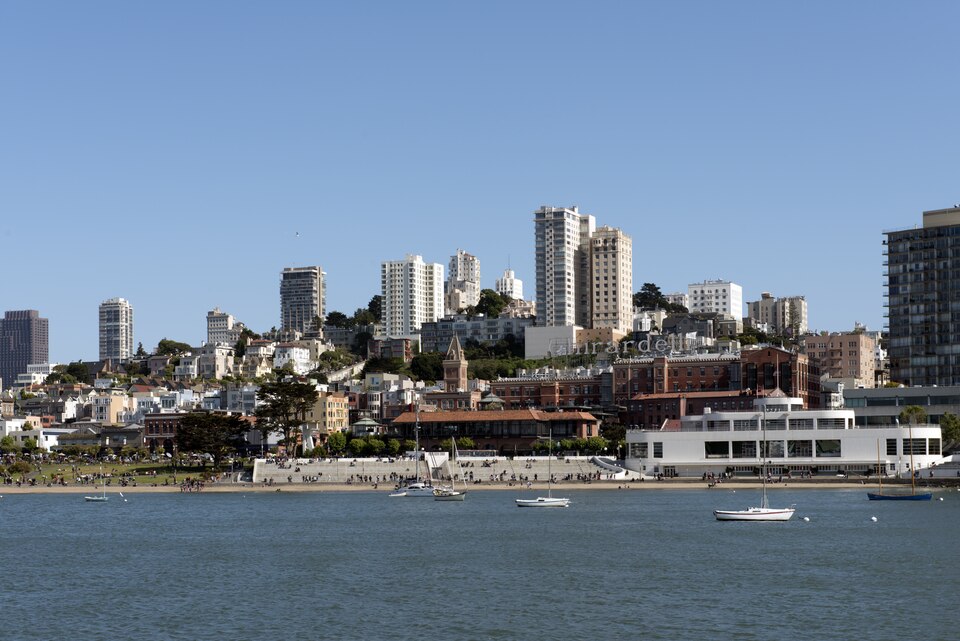
In the early 1960s the Golden Grain Macaroni Company bought the firm and moved production out to San Leandro. A group of San Franciscans bought the empty block rather than watch it come down, and the square opened on the 29th of November, 1964 — the first major adaptive reuse project in the United States, and the model Boston copied for Faneuil Hall and Baltimore for Harborplace. The brick buildings, the clock tower, the underground chocolate storage tunnels, and the views over the bay were preserved. Today it is a shopping and dining plaza. The chocolate shop still operates on the ground floor. The free sample is available at the counter — a single square of milk chocolate. You do not have to buy anything.

The Ice Cream Move

Go to the ice cream counter, not the chocolate counter. Order a hot fudge sundae. The fudge is Ghirardelli's own, and they make it in a copper kettle in the shop. If the line is too long, the original shop at the Ferry Building is usually shorter.

The checkable facts

  • Domingo Ghirardelli was born in Rapallo, Italy in 1817 and apprenticed to a Genoa confectioner
  • The company took over the Pioneer Woolen Mills on North Point Street
  • Domenico Ghirardelli purchased the entire city block in 1893
  • Golden Grain Macaroni Company bought the firm in the early 1960s and moved production to San Leandro

All the numbers, with sources →

After the guide

Practical bookings for this stop. These are affiliate links: they cost you nothing extra and they do not change what we recommend.

Hotels near this stop

Search stays nearby →

Data that works on landing

Get a local eSIM →

Frequently asked

Is chocolate still made here?
No. Manufacturing moved across the bay to San Leandro in the early 1960s and stayed there. What remains on the block is the brick shell of the plant, the illuminated rooftop sign, the clock tower and the retail store on the ground floor. The rest of the complex is shops and restaurants.
Who was Domingo Ghirardelli?
A confectioner born at Rapallo, near Genoa, in 1817. He trained in Italy, ran a shop in Lima, Peru, and reached California in 1849 hoping to sell sweets to gold miners. By 1852 he had premises in San Francisco. His name still sits on one of the oldest continuously operating chocolate firms in the country.
What does adaptive reuse mean?
Keeping an old building and giving it a new job instead of knocking it down. When the Roth family reopened the disused plant as shops and restaurants in 1964, working with landscape architect Lawrence Halprin and the firm Wurster, Bernardi and Emmons, the result became the American template for the idea.
Is the square legally protected?
Yes. San Francisco designated it a city landmark in 1970, and it joined the National Register of Historic Places in 1982. That status covers the brick factory buildings, the clock tower and the terraced plaza, which is why the complex still reads as a nineteenth-century industrial block rather than a modern mall.

Sixty seconds costs nothing

Judge the writing and the voice before you spend anything.