
Quick answer
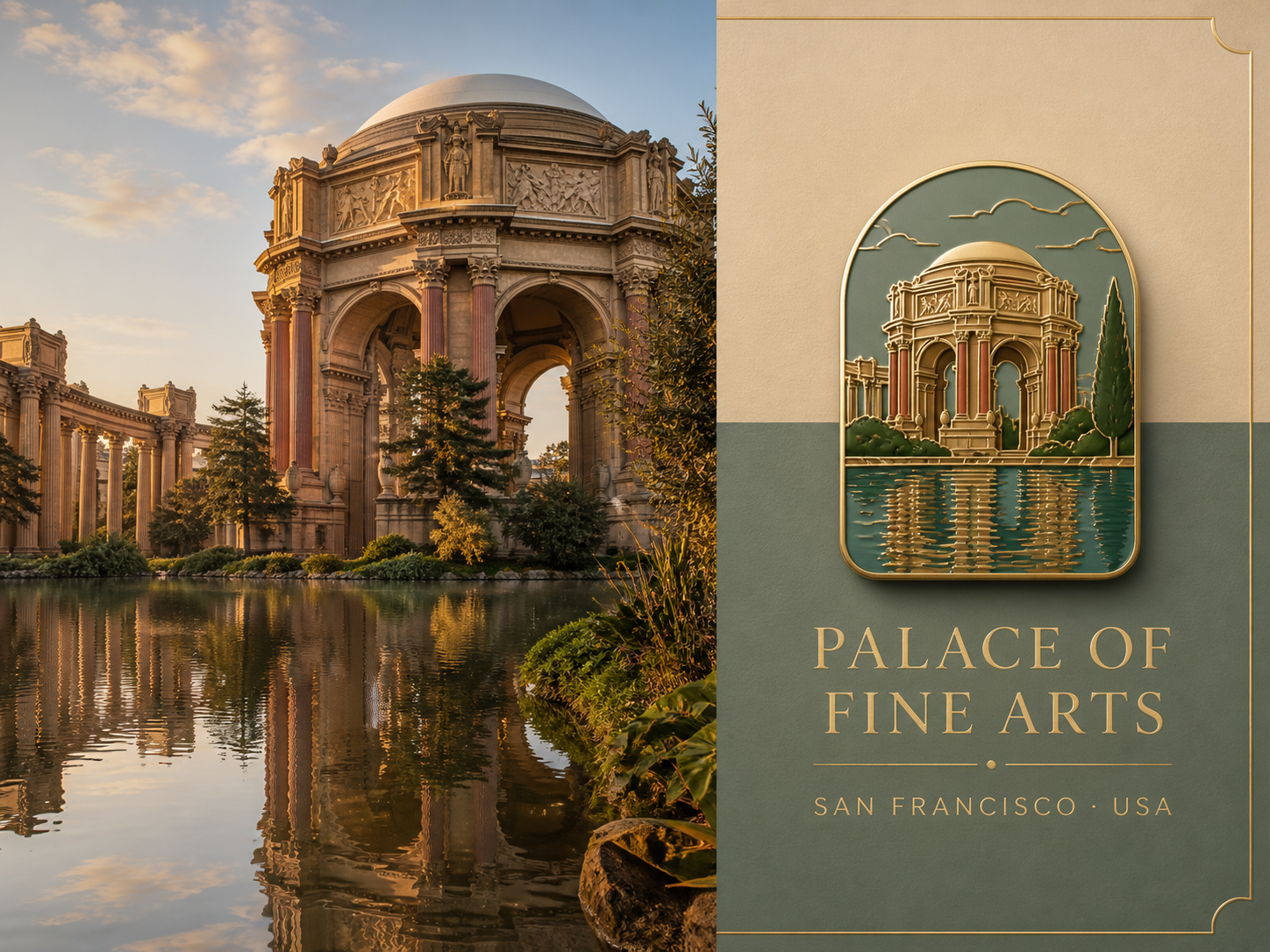
The Palace of Fine Arts was built for the 1915 Panama-Pacific International Exposition out of plaster and fibre over a wooden frame, designed by Bernard Maybeck to look like an abandoned classical ruin. It was meant to come down with the rest of the fair. Walter S. Johnson's $2 million gift in 1959 paid to recast it in concrete between 1964 and 1967.
Full transcript
Built to Be Temporary
In 1915 San Francisco threw itself a world's fair — the Panama-Pacific International Exposition — to celebrate the opening of the Panama Canal and, more importantly, to tell the world the city had come back from the 1906 earthquake. The fair covered this entire district. It ran for less than a year, and almost everything in it was designed to be demolished afterwards. That is why the Palace of Fine Arts was built out of plaster over a wooden frame, reinforced with burlap fibre. It looks like carved stone. It never was. The architect was Bernard Maybeck, and his charcoal sketch was accepted immediately, without argument, which almost never happens.
Sadness Modified by Beauty
What Maybeck designed was not a monument. It was a deliberate ruin — a Roman or Greek structure that had been abandoned, overgrown, and half forgotten, reflected in a lagoon. He said he wanted the feeling of, in his words, sadness modified by the feeling that beauty has a soothing influence. Look at the top of the colonnade and you will see the figures he used to get it: rows of women with their backs turned to you, heads bowed over the boxes they lean on. They are called the weeping women, sculpted by Ulric Ellerhusen, and their pose only makes sense from inside Maybeck's idea. They are mourning. Those boxes on the colonnade were meant to be planted, so that vines would spill down over the whole structure and finish the illusion. Maybeck's own wish was that the palace be allowed to decay, surrounded by redwoods, until it really was a ruin.
The City Said No
He got his wish for about fifty years, whether he wanted it or not. The fair ended, everything else came down, and the Palace stayed — slowly falling apart, put to use as a military storage depot, a Parks Department warehouse, a telephone book distribution center, and at one point temporary Fire Department headquarters. By the nineteen fifties the plaster was coming off in sheets. The argument over what to do with it was real, and demolition was on the table. Then in May 1959 a philanthropist named Walter S. Johnson announced $2 million to save it. Work began in 1964: the original was demolished and cast again in steel and concrete, this time permanently, and the rebuilt colonnade and rotunda were finished in 1967. So what you are looking at is a permanent reproduction of a temporary building imitating a ruin. And it works anyway. Come at dusk. Come after dark, when the lighting is aimed at the colonnade and the crowds are gone.